Software Just Entered Its Third Era (Loop-Native Era of Software). The Job That Runs It Pays $190K and Almost Nobody's Talking About It.
Every week another post shows up in my feed claiming AI is coming for developers. Someone shares a screenshot of Claude or GPT writing a full app in seconds, and the comments fill up with the same two reactions: panic, or denial.
I get why. It's an easy story to tell. AI writes code, so coders are doomed — right?
But while that argument keeps looping, something quieter and far more interesting has been happening. The biggest tech companies in the world just spent billions of dollars hiring for a role most people outside the industry have never heard of. Not a role that replaces engineers. A role that puts engineers directly inside client companies, building AI systems that actually work in the real world.
It's called a Forward Deployed Engineer, and if you work in tech, it's worth understanding why it exists.
AI Didn't Remove the Need for Engineers. It Moved Where They're Needed.
Here's the part the "AI is replacing jobs" narrative usually skips: building an AI demo is easy. Getting that AI to actually work inside a real company — with its messy data, its legacy systems, its specific workflows, its compliance rules — is genuinely hard.
A 2025 MIT Media Lab study found that roughly 95% of custom enterprise AI pilots show no measurable return. Not because the models don't work. Because fitting them into a company's real operations is a completely different problem than building a slick prototype.
That gap between "cool AI demo" and "AI that actually delivers results in production" is where the Forward Deployed Engineer lives.
Software Just Crossed Its Second Era, and a Third Is Already Arriving
It helps to zoom out for a second, because this isn't really about one job title. Software has moved through two eras and is stepping into a third.
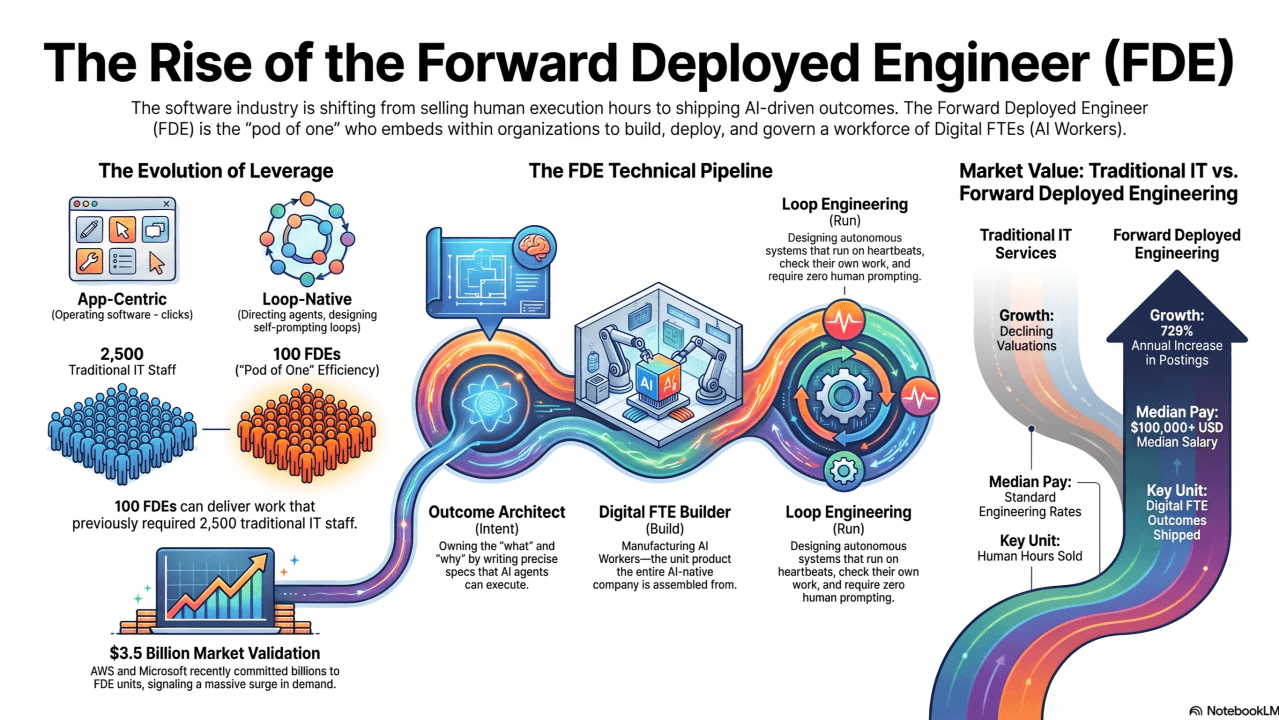
Era one, app-centric: you operate the software yourself. Every click, every field, every save is you doing the work — the app just holds the form.
Era two, agent-native: you direct the software. You state a goal in plain language, and an AI agent carries it out.
Era three, loop-native: it's arriving now — systems that prompt themselves. They run on a schedule, check their own work, and report back to a human who was busy doing something else entirely.
Here's a detail that made this click for me. Boris Cherny, who created Claude Code, said publicly this June that his own job has shifted — he's spending less time prompting the agent and more time writing the loops the agent now runs inside. Sit with that for a second. The person who built one of the most widely used agentic coding tools in the world doesn't spend his day prompting it anymore.
That's the real leverage a Forward Deployed Engineer brings. It was never about typing faster. It's about engineering the loop — designing the system that keeps running, checking, and correcting itself once you've walked away. One engineer who knows how to build a self-checking, self-running system can do the work that used to take a small pod of people manually operating the tools by hand. Multiply that across an entire company, and you land on the same arithmetic Sanjeev Aggarwal — founder of one of India's early BPO pioneers, Daksh, and now a venture investor — laid out publicly this July: a $100 million services business that once needed 2,000 to 2,500 people can now be run by roughly 100 Forward Deployed Engineers. He's describing his own projection for where the model is heading, not a measured result — but it's worth noticing whose projection it is. This is someone who built the old model, pointing at what replaces it.
What a Forward Deployed Engineer Actually Does
Most software engineers build a product at headquarters and rarely meet the people using it. A Forward Deployed Engineer does the opposite. They go on-site, sit with the people doing the actual work, understand the real problem, and build a working solution right there — using their company's platform, on the client's own data.
Not a slide deck. Not a proof of concept. Working software, running in production, solving a specific customer's problem.
Palantir is usually credited with pioneering this role back in the early 2010s. Their own way of framing it is the clearest explanation I've seen: a typical engineer focuses on one capability shipped to many customers. A Forward Deployed Engineer focuses on one customer, solving many capabilities for them. It's closer to being a startup CTO for a single client than it is to traditional software engineering.
It's also different from a Solutions Architect or Sales Engineer. Those roles exist to win the deal — demos, whiteboard sessions, proof-of-concept builds designed to convince someone to sign. Once the contract is signed, their job is mostly done. A Forward Deployed Engineer picks up right where that ends. They write the production code, on the client's real infrastructure, with real data, and they stay until the client is actually getting value.
Why Companies Are Suddenly Hiring for This Aggressively
The numbers here are the part that made me sit up.
In one week in June 2026, AWS and Microsoft between them committed $3.5 billion to building out Forward Deployed Engineering teams — AWS with a billion-dollar unit sending small engineering pods to clients, Microsoft with a $2.5 billion, 6,000-person operating unit embedding directly with companies like Unilever and Novo Nordisk.
The numbers, put together:
Median pay across the market sits around $190,000, with senior and staff-level FDEs at frontier labs clearing well into six figures beyond that. And it's not just AI labs and hyperscalers anymore — McKinsey's QuantumBlack is now hiring Lead Forward Deployed Engineers too, which tells you something: even the consulting world has accepted that advice without hands-on deployment doesn't sell the way it used to.
The freelance market has caught up as well. Upwork now runs a dedicated category for Forward Deployed Engineers, with project rates ranging from a couple thousand dollars for a first integration up to enterprise deployments well into five figures — a door with essentially no border on it, open to anyone with a portfolio, wherever they happen to be working from.
Why This Role Needs a Different Kind of Skill Set
This is the part I think is genuinely useful for anyone reading this and wondering what to do next.
Companies hiring for this role aren't looking for people who are good at prompting ChatGPT. They're looking for builders — people who can sit with a non-technical stakeholder, understand a messy real-world problem, and then actually build the thing: integrate LLMs, connect APIs, automate a workflow, deploy it on cloud infrastructure, and stay accountable until it works.
That means the skill set stacks up in a specific way: solid software engineering fundamentals, real experience working with LLMs and RAG pipelines, comfort with cloud deployment, and — maybe most underrated — the ability to talk to a customer directly and translate a vague business problem into something buildable.
None of those skills individually are new. What's new is that companies now need all of them in one person, embedded directly with the customer, instead of spread across five separate departments.
Put concretely, a Forward Deployed Engineer designs the day-to-day experience people actually use, not just the underlying model. They build human-agent teams with clear lines of accountability, so it's always obvious who signs off on what. They secure whatever they ship. And they can price the work honestly, because a working AI system isn't a demo — it's a unit of labor with real unit economics behind it, the same way a shift of human staff would be priced.
Where This Goes Next
I don't think the next five to ten years are about competing with AI. I think they're about learning to deploy it — inside real companies, on real problems, with real accountability for whether it actually works.
The people who spend their time arguing about whether AI will take their job are, in a strange way, missing the job that's already here. The demand isn't shrinking. It's shifting toward people who can bridge the gap between "AI is technically impressive" and "AI is actually delivering value for this specific business."
The future probably won't belong to the people who are most afraid of AI, or even the people who are most excited about it. It'll belong to the people who learn how to actually deploy it — in messy, real environments, for real customers, under real constraints.
That's a skill set. And right now, it's one of the most in-demand skill sets in the industry.
What skills do you think will define the next generation of AI engineers? And would you consider becoming a Forward Deployed Engineer yourself?