The Hidden Flaw in Most AI Agents (And How Memory Solves It)
Most AI agents today suffer from a hidden flaw — and it's costing them user trust every single day.
They forget.
Every conversation starts from zero. No context, no history, no awareness of who you are or what you've discussed before. It's like hiring a brilliant assistant who shows up with amnesia every morning. Technically capable, but practically frustrating.
This is exactly the problem that memory architecture in AI agents is designed to solve — and frameworks like LangGraph are leading the way in getting it right.
Memory Isn't a Feature. It's the Foundation.
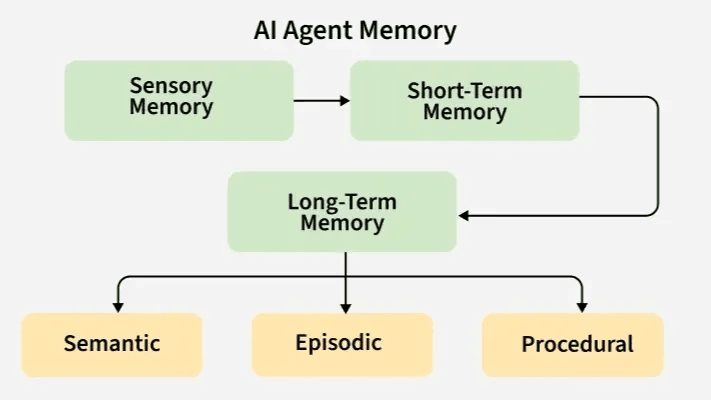
When we talk about memory in AI agents, we're really talking about two distinct layers working together.
The first is short-term memory — everything that happens within a single conversation. LangGraph handles this through a Checkpointer, which saves the full conversation state like a video game save point. You can pause, come back hours later, and the agent picks up exactly where you left off. But there's a catch: AI models can only process so much text at once. In long conversations, older messages start getting cut off. The solution? Either summarize past exchanges into a compact running brief, or filter out what's no longer relevant. Think of how a good lawyer doesn't re-read every case document daily — they work from a sharp, updated summary.
The second layer is long-term memory — and this is where things get genuinely powerful.
Three Types of Memory That Mirror the Human Mind
Cognitive psychology has long recognized that human memory isn't one thing. It's several. And AI agent memory follows the same logic, grounded in research from the CoALA paper.
Semantic Memory
Stores facts — user preferences, names, locations, habits. This is what allows an AI to remember that you prefer responses in Urdu, or that your budget for a project is a specific figure, without you repeating it every session. Netflix knowing your content preferences is semantic memory in action.
Episodic Memory
Stores experiences — specifically, examples of how the agent has successfully handled tasks before. This powers few-shot prompting, where relevant past interactions are retrieved and injected into the agent's context automatically. It's the difference between a new employee guessing how to fill out a form versus having a completed sample in front of them.
Procedural Memory
The most fascinating of the three. It stores the agent's own rules and instructions — its system prompt. And crucially, it can be updated through a process called reflection. The agent reviews its own recent behaviour, identifies gaps, and rewrites its instructions accordingly. An AI content tool that keeps receiving feedback about overusing hashtags can update its own guidelines — no developer intervention required. That's self-improvement built into the architecture.
When Should Memory Be Updated?
This is the engineering decision that often gets overlooked. There are two approaches.
Hot path updates happen during the conversation itself, in real time. The user sees what's being saved — transparent and immediate. The trade-off is speed: the agent is simultaneously responding and deciding what to remember, which can slow things down.
Background updates happen after the conversation ends, through a separate process. The main interaction stays fast and focused. The downside is a small delay — other conversations won't have access to the latest memories until the background process runs.
Neither approach is universally better. The right choice depends on your use case, your users' expectations, and how time-sensitive the memory updates are.
Why This Matters Right Now
We are in a period where the raw intelligence of AI models is advancing rapidly. But intelligence without memory is a frustrating experience. Users don't want to re-introduce themselves. They don't want to re-explain their preferences. They want an agent that gets smarter about them over time — just like a trusted colleague would.
Frameworks like LangGraph are making it practical to build exactly that. The architecture is already here. The question is whether the teams building AI products are designing memory into their systems from day one, or treating it as an afterthought.
In my experience, memory is what separates a demo that impresses from a product that people actually rely on.
Are you building memory into your AI agents? I'd love to hear what approaches your teams are using — hot path, background updates, or a hybrid?